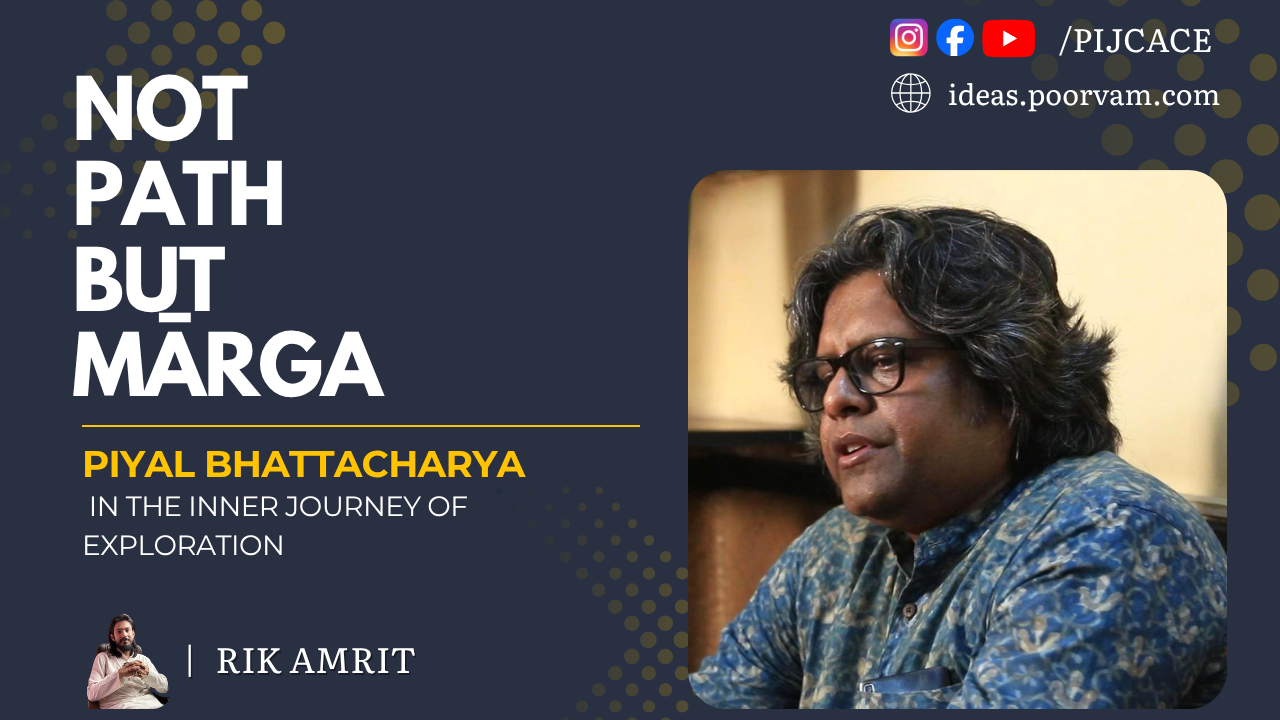


Amritanath Bhattacharya: The term “Mārga Nāṭya,” in reference to Bharata’s Nāṭya, had not been used by anyone before you. Why this particular term — “Mārga Nāṭya”?
Piyal Bhattacharya: There are two words — path and mārga. In Sanskrit, when we use the word patha or panthā, it refers to a definite route leading to a definite destination. But the word mārga carries within it the sense of mṛgyate — to be sought, to be pursued. Consider, for instance, a hunt. When someone goes hunting, the route of the hunt is never fixed. The objective may be definite — say, a deer or a boar — but the direction in which it will run, the moment it will leap, cannot be predetermined. In such a case, the goal is fixed, but the path is indeterminate. The hunter’s path is formed in the very act of pursuit. This path that comes into being through movement itself — that is mārga.
My own process is likewise not predetermined. It continues to take shape gradually, and perhaps it will go on doing so until the moment of my death. Even thereafter, if someone wishes to follow this lineage or this exploration of mine, this mārga will never become fixed in the manner of a path. Each one will have to create one’s own mārga. This is its essential implication.
My mārga has never confined my exploration within a predetermined route. When I began this work, in 1997, I was in a state of immaturity and incompleteness. Upon witnessing the dance of Padma Subrahmanyam in 1997, that dance itself emerged as the objective revealed in the course of my hunt. But in pursuing that objective, I have arrived somewhere today — just as, a few years ago, I had arrived somewhere else. Just as I did not know then where I would arrive today, I do not know now where I will arrive next. I do not know where I will stand even at the moment of my death.
This search, this pursuit, is therefore an unbroken play — what, in academic language, you might call a process.
In attempting to construct a method through which we may see, understand, and internalize the performing arts, I have moved forward keeping the Nāṭyaśāstra as the objective before me. Yet this objective will not be the same for everyone. What that objective is, and how it manifests, depends upon the individual. However, the essential meaning of the term itself remains unchanged.
Amritanath Bhattacharya: In post-Independence India, a movement known as the “Theatre of Roots” emerged. Broadly speaking, its aim was to rediscover our roots through theatre. Does Mārga Nāṭya follow that same path, or is its objective different?
Piyal Bhattacharya: My practice is neither separate from it, nor is it identical to it. In the Theatre of Roots movement, we suddenly turned toward the “root.” We came to know the root, and began making theatre using the materials of the root. But I ask a simple question: do we drink milk directly from the cow’s udder? No. We purify it; we subject it to a process. Why then should we apply the root to theatre in its unrefined state?
Bharata teaches us a method — the method of refinement. This method is called bhāvānukīrtana. The root shapes our consciousness; it forms our faculty of understanding — an understanding that can never arise merely from reading books. Now, the root is always bound to a specific space and time. By engaging with the root of a particular space-time, learning from it, and yet transcending that space-time, Bharata shows us the method through the principle of bhāvānukīrtana.
I too learned Kathakali by going directly to the root, learning within the guru-paramparā. And there I realized that Kottarakkara Tampurān, when creating Kathakali, never had to ask himself how he might become “rooted.” The very idea that one must consciously strive to be rooted appears to me, therefore, somewhat imposed.
Consider this: it is conventionally said that Kathakali was formed through various elements drawn from Kalaripayattu or Krishnanattam. But who determined this exchange, and when? Did that process arise from an anxiety about becoming rooted? Certainly not. In our tradition, whenever a new art form emerged, whenever it was nurtured and its principles or methods established, the authority of Bharata-sūtra was invoked.
This Bharata-sūtra is the utterance of a seer. And Veda — by Veda I do not mean the four Vedas alone — it is, in essence, the universal consciousness of the performing arts.
Therefore, the first task is to connect one’s intellect to such universal consciousness. For that connection, one requires a sūtra — and that sūtra is given by Bharata Muni. When is it given? When there is trust in Bharata. If one mistakes muni-consciousness for merely human consciousness, such trust cannot arise. I did not face that difficulty, because I learned within the guru-paramparā. I had trust in the Guru. Through that guru-consciousness, I was able to refine the theoretical dimension of what may be called the “root movement.”
My process, therefore, begins with the purification of the nābhi — the core. This process of nābhi-śuddhi exists in Kalaripayattu, from where it enters Kathakali; it is present also in Kūṭiyāṭṭam. In Kalaripayattu, this core is cultivated for combat; in Kathakali, it is adapted for performance; in Kūṭiyāṭṭam, it is further transformed according to its own performative requirements.
Can it then be said that my theatre is not rooted? Certainly it is. Therefore, to claim that my theatre, my Nāṭya, is not part of the “Theatre of Roots” would be untrue. The real question is this: how is the root refined?
I was born into a family, and the root of that family lives within me. Yet I do not behave exactly like every other member of my family. Why? Because I possess my own consciousness. That consciousness does not reject the family — it develops it. The root, too, must be developed in this way. It is not enough merely to use it; it must be carried through consciousness and transformed. And in Nāṭya, this very method is bhāvānukīrtana.
Amritanath Bhattacharya: Could you elaborate further on bhāvānukīrtana?
Piyal Bhattacharya: Even if one explains bhāvānukīrtana, it can never be fully understood. For bhāva is sattva — the very essence of truth. Bhāvānukīrtana means the re-articulation of that bhāva; in English, one may call it “retelling.” But before that, two things are necessary: first, deep review; and then, according to that review, the re-manifestation of the art, both inwardly and outwardly.
If I were to express it in academic terms, one must first review, and then redo.
Thus, when I perform Kathakali as a Bengali, it becomes my re-doing of Kathakali. Someone whose mother tongue is Malayalam, who is born into that consciousness, inhabits a sattva into which I cannot dissolve myself entirely. As Bengalis, we are contemplative by temperament. We question; we seek answers. Within our cultural inheritance flows the legacy of Abanindranath Tagore and Satyajit Ray. It was through that sattva that I was able, at a certain point, to redo Kathakali; and perhaps it is for this reason that I am able to do this work today.
This is the method and practice of bhāvānukīrtana. I do not believe it can be understood through intellectual inquiry alone. Another reason may be that my method is practice-based. Only through the review of an art and its re-manifestation can its sattva be re-articulated. It is an extremely rigorous epistemic method. The moment one attempts to explain it, complexity arises. But through practice, it becomes simple.
For this reason, in our tradition, certain sūtras have been left behind to avoid such complexity. These sūtras can be realized only through practice — never through explanation.
Amritanath Bhattacharya: Anyone who has experienced your Nāṭya knows that it is profoundly new — both in its subject and in its presentation. In dance, music, text, ornamentation, gesture, voice, props, and stage construction — what we call scenography — in almost every aspect, it does not resemble any precedent, not only in West Bengal but in India as a whole. Yet, newness does not necessarily mean that it is merely contemporary.
Piyal Bhattacharya: I do nothing new. As I said, I review the old, and then I redo it. I do not call that new.
Take this stage that you see before you. Is it new? No, it is not. If you visit a Namghar, you will see something similar there. But when I went to the Namghar, questions arose within me: why is it like this? I did not go and ask anyone there. I asked myself. If I had asked someone from that tradition, they would have given me a theoretical answer based on their lineage. That would not have been directly applicable to my Nāṭya. It would have needed to be refined before it could become useful.
Then I saw the Śrīyantra. I observed the structure of pyramids — in Egypt, in Mayan civilization. I realized that this was essentially an energy grid. If I create such an energetic field and speak within it, consciousness spreads very rapidly.
Now, why was this stage constructed in this way? This Nāṭya — Saugandhikāharaṇam — involves two characters: Hanuman and Bhima. One belongs to the Tretā Yuga, the other to the Dvāpara Yuga. It is a dialogue between two beings of different epochs. But we ourselves do not live across epochs; we live and end within a single span of time. We do not experience transitions between yugas. Therefore, the experience of epochal transition does not naturally arise within our awareness.
One who can perceive such transitions must exist beyond the spatial and temporal limits of our pañca-bhūta existence. To evoke that transcendence, we constructed this pyramid-like stage in five layers — each layer with its own colour. Seated beyond these layers of manifestation is Hanuman — a consciousness belonging to an earlier epoch, one that we neither fully accept nor fully understand.
Everything we do is oriented toward imagined futures. Our connection with the past exists either as emotional attachment or as neglect. It is not natural for human beings to live by directly assimilating the lessons of the past. How, then, could I express this multidimensional movement of time on stage?
Conventionally, one might suggest using the mattavarani. But instead of using the mattavarani, we thought differently. Yet this cannot be called new.
Within the Indian knowledge tradition — and by “Indian knowledge,” I do not mean Vedānta alone, but a much wider field of experience — such things cannot be fully explained in language. I simply revisited that field. As I said, I reviewed it. Through that revisiting, the question I carried within me found its answer. I then filtered that answer and applied it within Nāṭya.
Therefore, there is nothing new in my Nāṭya. Everything is refined from the old.
One person prefers perfume; another prefers attar. In this way, the adhikāra — the capacity of the receiver — differs.
No Indian śāstrakāra or artist has ever claimed to create something new. They have sought to realize universal consciousness, and through logical means, refinement, and internalization, they have re-articulated it — or, if you prefer, retold it.
Amritanath Bhattacharya: This is where my astonishment lies: I had never imagined that the Yakṣa’s longing in separation and the solitude of human beings during the lockdown could be strung together on the same thread. Even after reading so many classics, this had never occurred to me.
Piyal Bhattacharya: Such connections arise only when one’s inner orientation is different. I do not possess a Western orientation. From childhood, I grew up within Indian narratives, stories, and śāstra. As a result, I do not consciously seek to connect these things — they connect themselves.
If I encounter an old friend on the street and fail to recognize him, he will recognize me and call out, “Piyal… don’t you recognize me?” In just that way, during the lockdown, my past readings recognized that moment of time and called out from within me: “Do you now understand what the Yakṣa’s longing in separation truly was?”
Amritanath Bhattacharya: There is another dimension — the metaphysical. In your Nāṭya, one witnesses a movement from the mundane toward the metaphysical. What, then, is the metaphysical in your Nāṭya? What is adhyātma for you?
Piyal Bhattacharya: In truth, I have lived my entire life within the metaphysical. I inhabit the mundane world very little. Rabindranath spoke of the kalpaloka — and it is within that realm that I dwell. My room, my objects, colours, fabrics — everything I arrange differently. This has nothing to do with wealth. There was a time when I had no financial stability, and yet that kalpalokaexisted within me even then.
I never learned how to compromise with the metaphysical. I play the vīṇā. I rarely go outside. I have no friends. Even today, I do not use plastic flowers in my Nāṭya. I use flowers made of śolā, though they are more expensive. Because plastic carries no human consciousness within it.
None of the props in my Nāṭya are machine-made. Even the cloth you see hanging behind is entirely handwoven. I seek to bring together the consciousness of many individuals into a single locus, allowing a collective consciousness to condense and become present. It is within this condensation that the metaphysical emerges — the inherent potency of human consciousness.
Therefore, when we dismantle the stage, we do not treat it as inert matter. We perceive it as a form. This way of seeing brings about real transformation.
For this reason, in my process of Nāṭya-making, the consciousness of the śiśikṣu — the learner-disciple — is given primacy. There is little attempt to impose or force; instead, space is allowed for the inner consciousness to awaken through its own participation.
Amritanath Bhattacharya: Soon after receiving the Sangeet Natak Akademi Award, you said in a conversation with an English portal that, as an artist, you believe in “totality.” From the time I have spent with you, I sense that by totality you do not mean material completeness, but rather a kind of fullness. Is that so? If so, could you explain what constitutes fullness for an artist? What is this sense of fullness?
Piyal Bhattacharya: It differs from artist to artist. I cannot define it — because to define it would become an act of imparting knowledge. I perceive fullness simply as fullness.
I wish to break myself apart. I wish to move beyond my limits. I want to float in the infinite; I do not wish to remain confined within limitation. Fullness, for me, is not an end — it is a pursuit toward the infinite.
Amritanath Bhattacharya: When these works are presented on stage, when Sayak recites śāstra, even those in the audience who do not know Sanskrit feel its essence and respond with spontaneous applause. Members of Gen-Z create reels, while viewers unfamiliar with the subject and its mode of presentation nevertheless forget their spatial and temporal coordinates and become absorbed in the aesthetic experience of the performance. As the creator, how do you perceive this? Is this the Indian consciousness that lies deeply dormant within, and awakens at a single touch?
Piyal Bhattacharya: My understanding is that whatever may be called the “material attraction” of my Nāṭya is responsible for this. I do not think in terms of whether someone responded after seeing, or after understanding.
Someone creates a reel and says it has received many views, and that makes them happy. But if I were to say that when I walk down the road, cows, calves, crows, animals, birds, trees, mountains, dust, houses — everything is looking at me, and therefore I must be someone of great importance — I would consider that a symptom of madness. But that is my view. I do not know the view of others.
Amritanath Bhattacharya: Three decades ago, there was a certain sense of necessity behind this practice. Do you still feel that same necessity today?
Piyal Bhattacharya: Three decades ago, I did not possess mental maturity. I did not know what consciousness was. The upheavals of life taught me. (Pauses.) One cannot become conscious — one can only cease to remain unconscious.
Now, my life has no specific purpose. Therefore, I feel no urgency to establish this Mārga Nāṭya within society. At one point in my life, I realized that I was the epitome of unconsciousness, and that was the cause of all my suffering. I have been attempting to move beyond that suffering.
Because I have seen that if I experience suffering, that frequency is transmitted to others as well. Therefore, if I wish that others suffer less, I must first transcend the level of my own suffering. That is the work I have done through art. I am a born artist. It seemed to me that this is what I must do.
(Pauses again.) Nothing in life is planned. Whether something happens or does not happen — both are acceptable. Yet work must continue. One must take care of people, maintain buildings, arrange for resources. The day I am able to move beyond these necessities, I will no longer require money — that is the plan.
We create nothing. We merely carry the arrogance of creation. Even if we build a house, the land belongs to the earth, the bricks belong to the earth, the cement belongs to the earth. Everything is borrowed from the earth.
I have the wish to build a Bharata Nāṭya Maṇḍapa. It has seemed to me that nothing exists on this earth in the name of Bharata Muni. Many attempts have been made, but it has not come into being. I will attempt it once myself. I do not have the confidence that I will succeed — but there is no harm in trying. If it comes into being, it will come into being. If not, then wherever I arrive at the end of my life, I will erect a simple structure of brick and bamboo, dedicate it, and depart.
That earlier sense of necessity no longer returns to me now.
Do we live only in response to necessity, or is there something beyond necessity? That is the real question.
Amritanath Bhattacharya: Let us now turn briefly to West Bengal. Over the past seventy years, what has been most widely practiced here has been political theatre, much of it shaped by colonial inheritances. What is your view on this political theatre of Kolkata?
Piyal Bhattacharya: I do not encounter so-called political theatre in that sense, nor do I have the opportunity to observe it closely. In truth, art is an expression of the inner consciousness of the individual. One whose inner consciousness is shaped by politics will create political theatre.
I am not connected with politics. Whether politics is underlined within my theatre or not — that is for others to perceive, if they can. I will not tell the audience what it is that I am showing through my Nāṭya.
If someone declares, “I am presenting politics,” that appears to me to be a form of foolishness.
In our country, what we call politics is something we ourselves do not fully understand — and it is precisely because of this lack of understanding that we become subject to it.
Amritanath Bhattacharya: Across West Bengal — whether in the districts or in Kolkata — theatre practice has become deeply dependent on grants from MoC, GoI. Yet even within such structures, fragmentation, internal conflict, slander, and ultimately insecurity remain common experiences. And yet, from within the very centre of this ecosystem, without relying on salaries or grants, without proximity to power or patronage, and without taking any money from students, Chidākāśa has survived for more than a decade and has become one of the country’s most active institutions. If someone were to ask how this has been possible, what would you say?
Piyal Bhattacharya: Grants have their necessity — I do not deny that. But I was never aware of such things in my own life. I did not come from any position of institutional support. I learned art and conducted my research through my own earnings.
Amritanath Bhattacharya: May I ask a personal question? Many people do not know that you are a descendant of Mahāmahopādhyāya Haridās Siddhāntavāgīśa, the great commentator on the Mahābhārata. From Mahāmahopādhyāya Haridās Siddhāntavāgīśa to Mahāmahopādhyāya Piyal Bhattacharya — does it ever feel to you as though a circle has been completed?
Piyal Bhattacharya: That “Mahāmahopādhyāya” was something I once wished to become — but I could not. When I studied Sanskrit, I felt a deep attraction toward such scholarship. I thought I would pursue extensive study. But I lived alone; I had no support structure. Eventually, I was unable to complete my formal studies. I have no hesitation in admitting that.
Sometimes, when something lies beyond the capacity of a child, the father comes and says, “You wanted a bicycle, didn’t you? Here, I have bought it for you.” In the same way, I had a curiosity about what it meant to be a Mahāmahopādhyāya — not an ambition to become one, but a desire to understand it. And then one day, someone simply conferred the title upon me.
Am I truly worthy of it? I have my doubts. That is why I do not write it before my name.
A great Guru felt that I was a Mahāmahopādhyāya in this field, and so he gave it. It is strange. In fact, I was supposed to receive the Puru Dadhīca honour. Suddenly, one day, I was told, “You are being given this title.” I was surprised — “Why me?” Yet it was given. I have kept it hanging on the wall of my room.
Amritanath Bhattacharya: My final question. Awareness of the Nāṭyaśāstra has increased considerably in recent years. It is now frequently referenced in seminars, podcasts, and discussions on artistic practice. Several years ago, a leading English daily described you as the ‘Guru of a Lost Tradition.’ What advice would that Guru offer to those who are curious about and drawn toward the Nāṭyaśāstra?
Piyal Bhattacharya: I have no advice to give.
If curiosity has arisen within someone, they will come to know — this is what I believe. The answer already exists within our śāstra; that is why the question has arisen in the first place. If a question has awakened in their mind, the path will also open.
But they must know in their own way. If they know it in my way, it will become a problem.
One who truly wishes to know will know.
I would be happiest if they did not come to me at all.
That is my only advice.