The Goddess tradition is one of the most prominent among Hindu cultures and even Buddhist, Jain, or Sikh traditions preserve some aspects of worshipping the divine feminine. Historically, cultures worldwide once worshipped the Mother. Unfortunately, even among the Hindus, the prominent aspect of Goddess worship is reserved to rituals and its association with the occult.
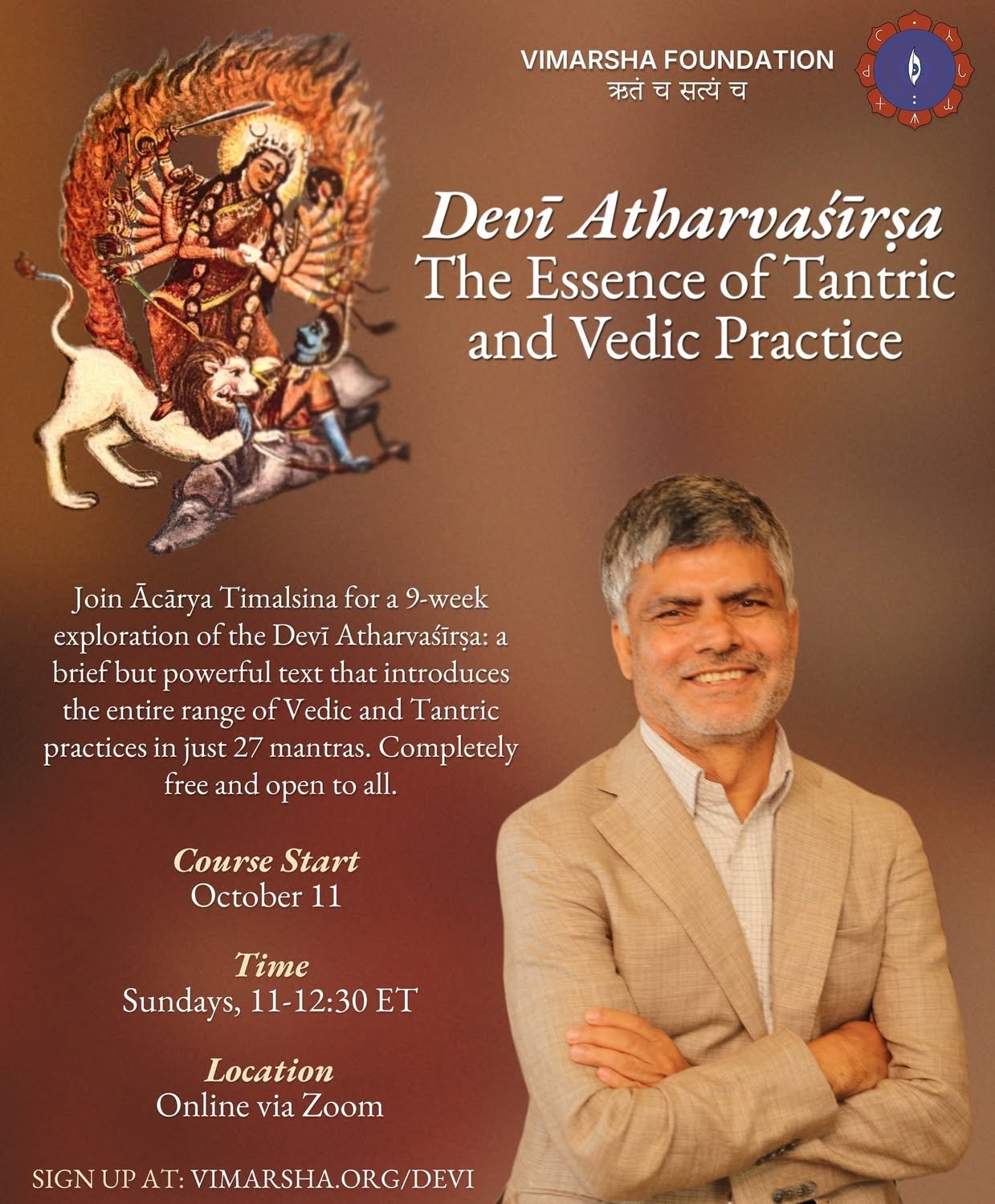
In order to counter this stereotype, I am offering a free 9 week long course on the philosophy of the Goddess based on the text: Devī Athara Śīrṣa. This text helps us deepen our knowledge of Shakta philosophy and also realiz
The Goddess tradition is one of the most prominent among Hindu cultures and even Buddhist, Jain, or Sikh traditions preserve some aspects of worshipping the divine feminine. Historically, cultures worldwide once worshipped the Mother. Unfortunately, even among the Hindus, the prominent aspect of Goddess worship is reserved to rituals and its association with the occult.
In order to counter this stereotype, I am offering a free 9 week long course on the philosophy of the Goddess based on the text: Devī Athara Śīrṣa. This text helps us deepen our knowledge of Shakta philosophy and also realize that the dichotomy between Veda and Tantra is not real, and that the Tantric divide of Kali Kula and Sri Kula is not based on fact, and that the Goddess can be invoked at the same time engaging different streams of transmission. I welcome you to this course.
Vimarsha Foundation is a modern school (gurukula) for teaching and reflecting on the ancient wisdom of ṛṣis and siddhas.
Philosophically, vimarśa is the reflective mode of consciousness that makes consciousness self-aware. Theologically, vimarśa is Mother Śakti. Metaphysically, vimarśa is everything that exists as 'this' (idam).
Our logo is itself a depiction of this profound concept. The inner eye is wisdom, light. In the center is a blue circle, the empty space, permeated with the rays communicating with the petals. Bindu and visarga stand for prakāśa and vimarśa. The phonemes (ka, ca, ṭa, ta, pa, ya, śa), written in Brahmī script, are central mātr̥kas, the matrices giving rise to the world. The outer white circle refers to knowledge spread throughout the world.
Disclaimer
The views and opinions expressed by contributors, authors, guests, or users are their own and do not necessarily reflect the official policy, position, or opinions of Poorvam.
Ācārya Dr. Sthaneshwar Timalsina is the founder of Vimarsha Foundation and the Endowed Chair of Indic Studies at Stony Brook University, New York. Originally from Nepal, he received traditional training in the Vedas, Vedānta, Tantra, and Śaiva philosophy, alongside advanced academic training in classical Indian philosophy, earning his PhD from Martin Luther University, Germany. Having taught at several American universities, he is dedicated to preserving and revitalising India's philosophical and contemplative traditions through academic research, institutional initiatives, and global education. Founded in 2019, Vimarsha Foundation advances the study of Hindu philosophical traditions through structured courses and scholarly engagement.
Retain the author attribution and original link. Do not edit the article. Non-commercial use only.
A New Course on Śākta Philosophy
By sthaneshwar Timalsina · October 13, 2026
The Goddess tradition is one of the most prominent among Hindu cultures and even Buddhist, Jain, or Sikh traditions preserve some aspects of worshipping the divine feminine. Historically, cultures worldwide once worshipped the Mother. Unfortunately, even among the Hindus, the prominent aspect of Goddess worship is reserved to rituals and its association with the occult.
In order to counter this stereotype, I am offering a free 9 week long course on the philosophy of the Goddess based on the text: Devī Athara Śīrṣa. This text helps us deepen our knowledge of Shakta philosophy and also realize that the dichotomy between Veda and Tantra is not real, and that the Tantric divide of Kali Kula and Sri Kula is not based on fact, and that the Goddess can be invoked at the same time engaging different streams of transmission. I welcome you to this course.
Vimarsha Foundation is a modern school (gurukula) for teaching and reflecting on the ancient wisdom of ṛṣis and siddhas.
Philosophically, vimarśa is the reflective mode of consciousness that makes consciousness self-aware. Theologically, vimarśa is Mother Śakti. Metaphysically, vimarśa is everything that exists as 'this' (idam).
Our logo is itself a depiction of this profound concept. The inner eye is wisdom, light. In the center is a blue circle, the empty space, permeated with the rays communicating with the petals. Bindu and visarga stand for prakāśa and vimarśa. The phonemes (ka, ca, ṭa, ta, pa, ya, śa), written in Brahmī script, are central mātr̥kas, the matrices giving rise to the world. The outer white circle refers to knowledge spread throughout the world.
This article was originally published on Poorvam Ideas under a Creative Commons Attribution-NonCommercial-NoDerivatives 4.0 International (CC BY-NC-ND 4.0) licence.
Privacy
Cookies on Poorvam
We use necessary cookies to keep Poorvam secure. Optional cookies
help us understand how the site is used and remember your preferences.
Read our Cookie Policy.
Privacy
Cookie preferences
Cookies help Poorvam keep the site secure and improve your experience.
Necessary cookies are always active. You can choose whether to allow
the optional categories below.
Strictly necessary
Always active
Required for platform security, authentication, CSRF protection,
manuscript submission tokens, shopping cart sessions and certificate verification.
Session to 30 days · PHPSESSID, csrf_token, poorvam_session,
poorvam_cookie_consent
Analytics
Optional
Helps us understand readership and page use through aggregated
analytics.
Up to 1 year · Google Analytics 4 (_ga, _gid)
Preferences
Optional
Remembers selected reading and interface preferences where supported.
Up to 1 year · poorvam_reader_theme, poorvam_font_size, poorvam-theme
Academic sponsorships
Optional
Supports partner announcements, book offers and non-personalised
sponsorship measurement.