Registration Open
Authors in Conversation
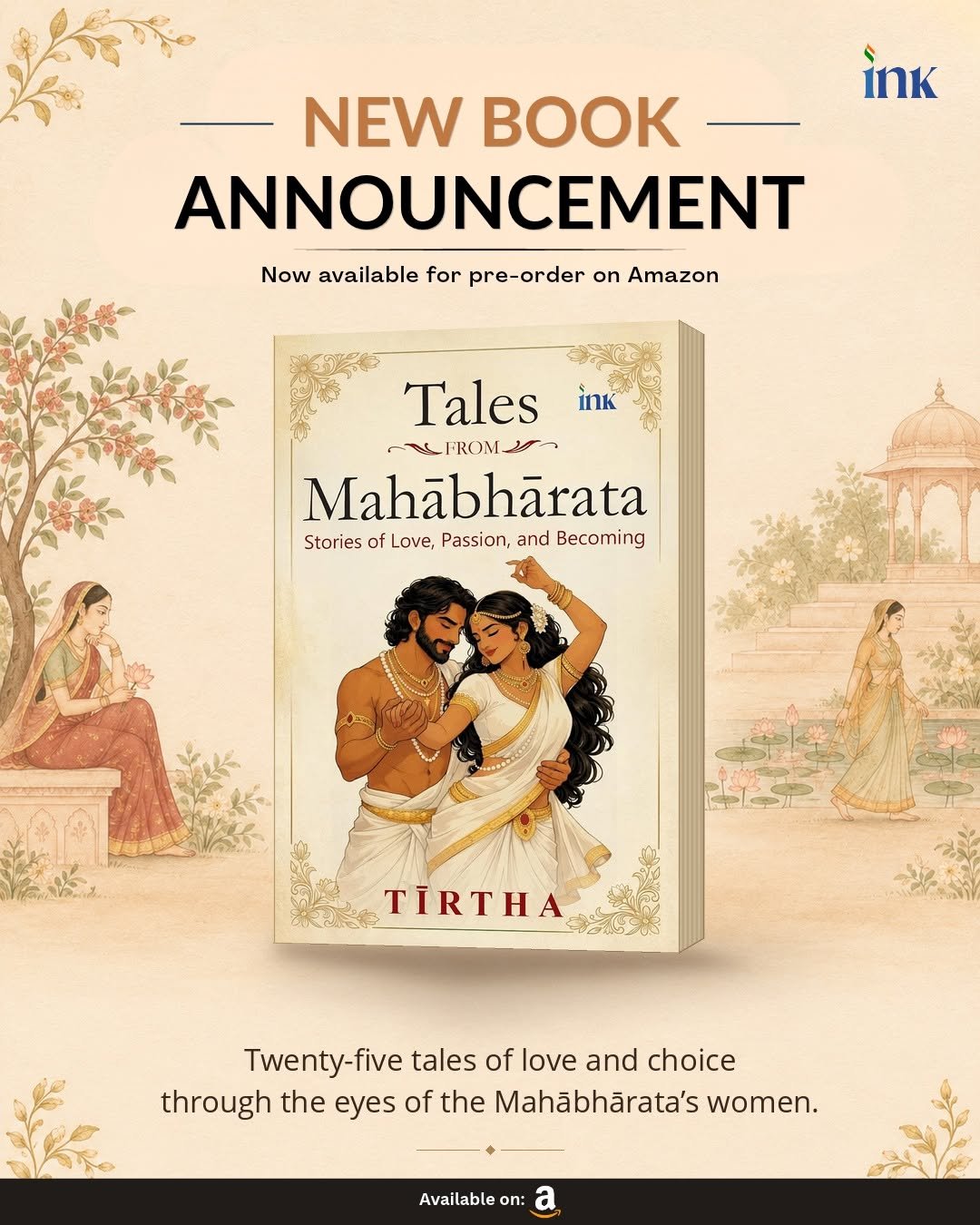
Exploring the Tales from Mahābhārata: stories of love, passion and becoming
With Keynote Speaker Tirtha
(Moderated by Nilambar Chakrabarti)
Sunday, December 06, 2026
6:00 PM IST
Online (Microsoft Teams)
Free Admission

Academic Discourse Overview & Abstract
Tales from Mahābhārata, in two volumes, is a collection of fifty interconnected love stories and it has been conceived as the first installment of the Love Tales Trilogy, the other two being Tales from Rāmāyaṇa and Tales from Purāṇas, whose works began almost concurrently. Whereas the first one contains fifty love stories from the world’s lengthiest ever written epic, the latter two contains twenty-five and thirty-three stories respectively from the aforementioned texts, making the entire omnibus a collection of 108 love stories. All fifty stories of the Tales from Mahābhārata have been titled after their female protagonists. Thus, it is projected to be one of a unique literary opus in itself.
While rooted firmly in classical sources, Tales from Mahābhārata offers original fictional retellings that explore emotional interiors, ethical tensions, philosophical depth, and social realities often left in the margins of epic narration. Each story is titled after its female protagonist, making the collection a unique literary opus that re-centres the Mahābhārata’s vast universe around women’s voices. The book presents them as thinkers, lovers, doubters, aspirers, and agents of destiny. Love here is not reduced to romance alone for it unfolds as intellectual companionship, moral struggle, spiritual longing, political alliance, sacrificial devotion, and self-realization.
These stories are not just plain blunt ‘love stories’ for the sake of ‘love stories’. Rather, these stories are portals that take us to untrodden dimensions— from the societal roles and expectations to the political mechanisms, from the recondite philosophies to the ethical stances, from the metaphysics of the mantras to the science of the matter. Take for instance, the arguments between Śvetaketu and Suvarcalā in the story ‘The Sapiophile Lady’ when she heralds of a svayaṁvara where she tests her to-be husband on intellectual merits or the story of ‘The Chaste Wife’ where Sāvitrī goes on to a one-year-long journey to find a suitable match for her when her father fails to do so. What do these stories imply, but the utmost respect to a woman’s free will? Similarly, ‘The Black Beauty’ breaks the myth that a woman has to be fair and slim in order to be attractive for Hiḍimbī is a dark, chubby woman in whom the fair, stoutly built Bhīma finds his most beloved wife. On the contrary, in the story ‘The Princess in a Forest’, the fair and young princess named Sukanyā is married to the middle-aged, emaciated ascetic Cyāvana to whom she was married by perchance but slowly grew her love and reverence— so much so that she would refuse the handsome and ever-young Aśvin-brothers who were the deities of heaven. ‘The Huntress’ delves into the apparent la belle dame sans merci figure of Suśobhanā who punishes the cruel hunters who slay the wild animals for mere sport. ‘The Fisherwoman’ and ‘The Ambitious Lady’, when juxtaposed side by side, shows the change of character that women undergo the reversal of fate. The metamorphosis of the fisherwoman Matsyagandhā into Satyavatī, the queen of Hastināpura, shows the dichotomy of a woman’s psyche from melancholy to ambition. The pangs of dilemma that Guṇakeśī undergoes in ‘The Lady with Long Hair’ whether to sacrifice her identity to save her lover or to empower her lover to save himself keeping her identity intact shows the constant battle of thoughts that goes on in a woman’s head. Put this sharply in contrast to Kapotī’s unflinching sacrifice of her own life in bereavement of her husband in ‘The Dove’s Wife’. The schema of these stories are not to deify women as goddesses, neither to vilify them as witches, but to paint them in the polychromatic frescoes: luminous and flawed, resolute and wavering, tender and fierce.
The book seeks to restore to them the complexity that epic brevity often withholds. The narrative canvas ranges from royal courts and hermitages to forests, riversides, and battle-shadowed cities, presenting love as a force that shapes both private lives and civilizational currents. This book is the result of eight years of sustained research, close reading of critical editions and retellings, and creative engagement with the Mahābhārata tradition, seeking to bridge classical depth with contemporary literary sensibility.
Distinguished Keynote Speaker(s)
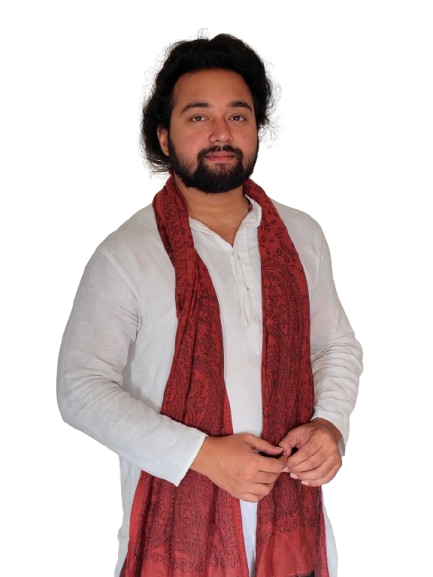
Tirtha (also known as Dr. Tirthendu Ganguly) is a poet, author, and researcher. He has
penned a collection of hundred-and-eight poems titled Firefly of Love (ISBN: 9781794652149)
and his next book, Tales from Mahābhārata, a collection of fifty short stories, is soon to be
published. His poetry, stories, and articles have appeared on multiple national and international
journals, magazines, and conference proceedings. He has been awarded a Ph.D. degree by the
Department of English at Banaras Hindu University on the doctoral thesis titled, The Ontology
and Aesthetics of Bhakti in the Hagiographies of Śrī Caitanya.
At present, he is working as an Assistant Professor in the Centre for Indic Studies at
Indus University. He is also the Editor-in-Chief of the Journal of Sanātana Dharma (ISSN:
3107-9660 & 3108-060X). Previously, he held the post of the Editor-in-Chief at The Indian
Rover, a multilingual literary magazine, for two years. He was a teaching instructor of
communicative skills at the Institute of Agricultural Sciences, Banaras Hindu University. He
also has a few laurels to his credit. He is the recipient of the Research Excellence Award (2020),
India Book of Records (2021), and Kalam Ratna Award (2021). In 2022, he was bestowed the
honorary title of Kentucky Colonel by the Governor of Kentucky (USA).
Session Moderator
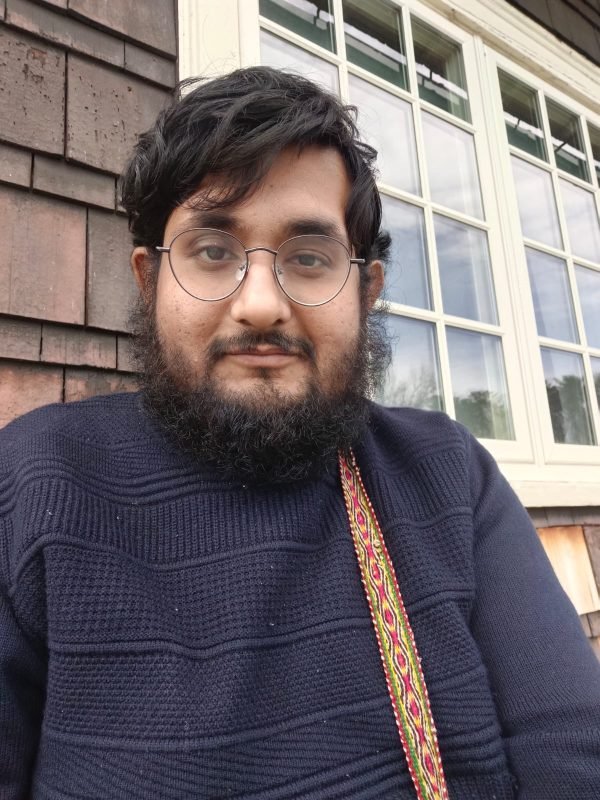
Nilambar Chakrabarti is a doctoral research scholar in Philosophy at Jadavpur University, a Sylff Fellowship recipient, and former Research Fellow at Smith College in South Asian Studies. He regularly moderates the Poorvam Cite It! and Authors in Conversation academic symposia series.