Ideas is now live — the new home for long-form reading on poorvam.com
Who Are You, Really? Fernando Pessoa's Strange Answer
Books · 6 min read

Who Are You, Really? Fernando Pessoa's Strange Answer

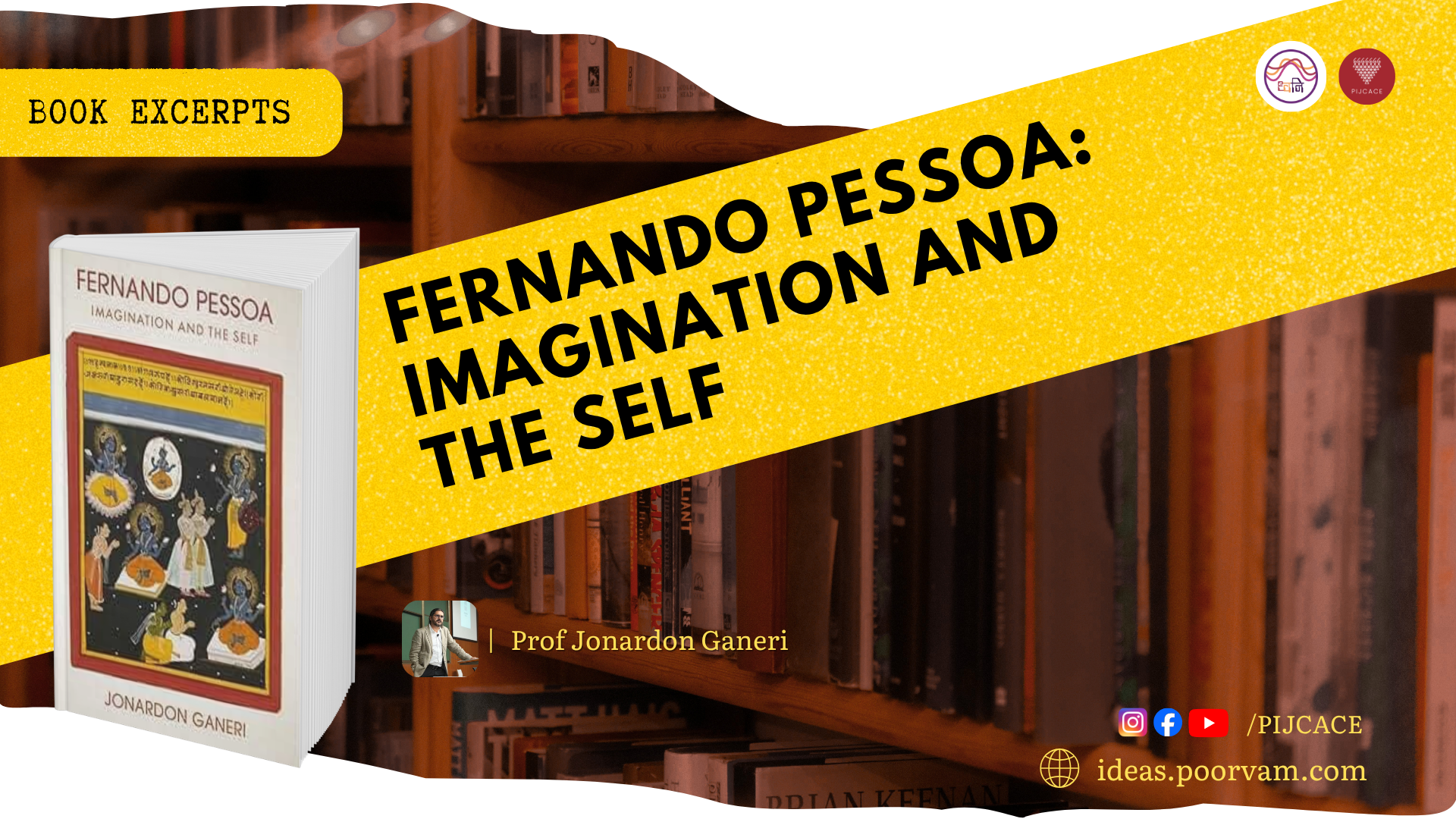
Adapted from "Fernando Pessoa: Imagination and the Self"

A look at how Portuguese poet Fernando Pessoa invented over a hundred inner selves, and why the questions he asked about identity echo ideas Indian philosophy has grappled with for centuries.

Try this for a moment. Imagine you are a fly.

What does that look like in your head? You might picture yourself in a tiny body, buzzing around, seeing the world from a fly's point of view. Or you might go further and actually imagine becoming a fly, with a fly's desires, a fly's limited brain, a fly's strange way of sensing the world.

These are two very different things. The first is like wearing a costume. The second is a complete change of who you are from the inside.

This question, simple as it sounds, sits at the heart of one of the most unusual literary lives in modern history.

The Man Who Was a Hundred People

Fernando Pessoa was a Portuguese poet who lived from 1888 to 1935. He worked as a translator in Lisbon by day and wrote furiously at night. When he died, he left behind a large wooden trunk filled with more than 25,000 pages of unpublished writing. On the surface, he seemed like a quiet, unremarkable man. Inside, he was doing something no other writer had quite done before.

Pessoa invented other people and then became them.

Not characters in a novel, who do things while the author watches from outside. Pessoa created other poets, gave them full biographies, different childhoods, different beliefs, different ways of seeing. And then he wrote as them, from the inside, fully entering their way of experiencing the world.

The three most developed of these were Alberto Caeiro, who believed in living without thought, only raw sensation; Ricardo Reis, calm and classical, rooted in ancient stoic ideas; and Álvaro de Campos, restless, modern, overwhelmed by the intensity of everything. These three were not masks Pessoa wore. They were, he insisted, genuinely other people who happened to live inside him.

He called them his heteronyms, from the Greek word for "having the name of another."

What Indian Philosophy Knew First

This idea, of a person becoming not one but many selves, is not entirely new to Indian ears.

Think of the concept of avatara. We use the word "avatar" today for our online profiles and gaming characters. But the original Sanskrit word described something far more layered: a god descending to earth. The real question the old stories always circled around was this. When Vishnu comes down as Krishna, is it still Vishnu wearing a human body? Or has something deeper changed? Has Vishnu, in some essential way, become human?

The Yogavasistha, the great Kashmiri philosophical storybook that is over a thousand years old, tells the story of a doe who falls asleep and sees herself as a bee. Not just inhabits a bee's body. Sees herself, from the inside, as a bee. Another story shows the sage Narada being made by Vishnu to live as a woman named Saubhagyasundari, forgetting his earlier life entirely. When Narada wakes up from this experience, what does he say? Was he himself in a different body, or was he, during that time, genuinely someone else?

Pessoa was grappling with exactly this question, only through poetry rather than scripture.

"Be Plural Like the Universe!"

Pessoa once wrote a note to himself on a scrap of paper. It said: "Be plural like the universe!"

For him, this was not a poetic flourish. It was a serious philosophical claim. The universe contains everything. Every kind of thing, every way of being. A person who wants to fully live must find a way to contain that same plurality inside themselves.

Most of us move through life with one consistent self. Same name, same memories, same basic way of looking at the world. Pessoa found this unbearable. Not because he was troubled or confused, but because it seemed to him like a terrible waste. If you are only ever yourself, you miss the experience of the whole world.

His solution was to become, through imagination, genuinely other people. Not to pretend to be them. Not to imagine what they might think, from his own safe vantage point. But to actually shift his entire way of seeing, feeling, and experiencing the world until he was, for the duration of a poem, someone else entirely.

He described this higher level of imagination as the goal of what he called "dreaming for metaphysical minds": imagining not just one other person, but several simultaneously, until the self scatters like ash and something much larger remains.

A New Kind of Reality

The philosopher Jonardon Ganeri, who has written this remarkable study of Pessoa, argues that the poet was developing something like a philosophy of virtual reality, centuries before computers made that phrase common.

We understand today that a virtual object, generated by a computer, can be genuinely real in important ways. It exists. You can interact with it. It affects you. Pessoa was asking a similar question about the self. If I fully imagine being someone else, from the inside, with their feelings and their way of seeing the world, is that "other me" not, in some meaningful sense, real?

Where most philosophers and writers stopped at virtual objects, Pessoa went further. He proposed that there could be virtual subjects, virtual selves. The avatars of video games are just bodies controlled by a player who remains the same person throughout. Pessoa's imagined others were something more. They were whole ways of being in the world. Different bearings, as Ganeri puts it.

Pessoa himself put the question beautifully: he did not know whether Hamlet or Shakespeare was more real. If the creator fully becomes the created, who exactly is the real one?

Why This Matters to Us

Reading Pessoa through the lens Ganeri offers is a strange and quietly thrilling experience, especially for readers familiar with Indian philosophical traditions. The questions Pessoa was asking in early twentieth-century Lisbon are questions that Indian philosophy had been taking seriously for a very long time.

What makes a self? Is it a body? A continuous stream of memory? A consistent point of view? Or is the self more like a style, a particular way of attending to the world, which can in principle be changed, multiplied, shared, and even given away?

The Bhagavad Gita asks Arjuna to act from a position of non-attachment to his own ego. The Advaita tradition questions whether the individual self is ultimately real at all. Pessoa, working entirely outside these traditions and yet arriving at strikingly similar questions, suggests that something important is being touched here. Something about the nature of consciousness and identity that human beings keep returning to, through very different routes.

His answer was to write. To fill over a hundred imagined lives with real thought, real feeling, real poetry. To be, as he said, everything at once: scattered, extravagant, complete, and aloof in a single moment.

Whether or not we can ever truly be plural like the universe, Fernando Pessoa makes us feel, for the length of a poem, that the attempt is worth making.


"Fernando Pessoa: Imagination and the Self" by Jonardon Ganeri is published by Oxford University Press (2024). Ganeri is a philosopher known for his work bridging Western and Indian philosophical traditions.

Editorial Desk
About the Author
Contributing Author

View Profile →