A philosopher asks whether the self can exist without others, drawing on phenomenology, Indian thought, and the shared experiences that make us who we are.

Think about the last time you watched India win a cricket match. You were not just happy. You were happy with someone. Your joy changed shape because others were sharing it. When Virat hit that winning six, the stadium did not contain thousands of separate private joys. It held one big, beating, shared feeling.
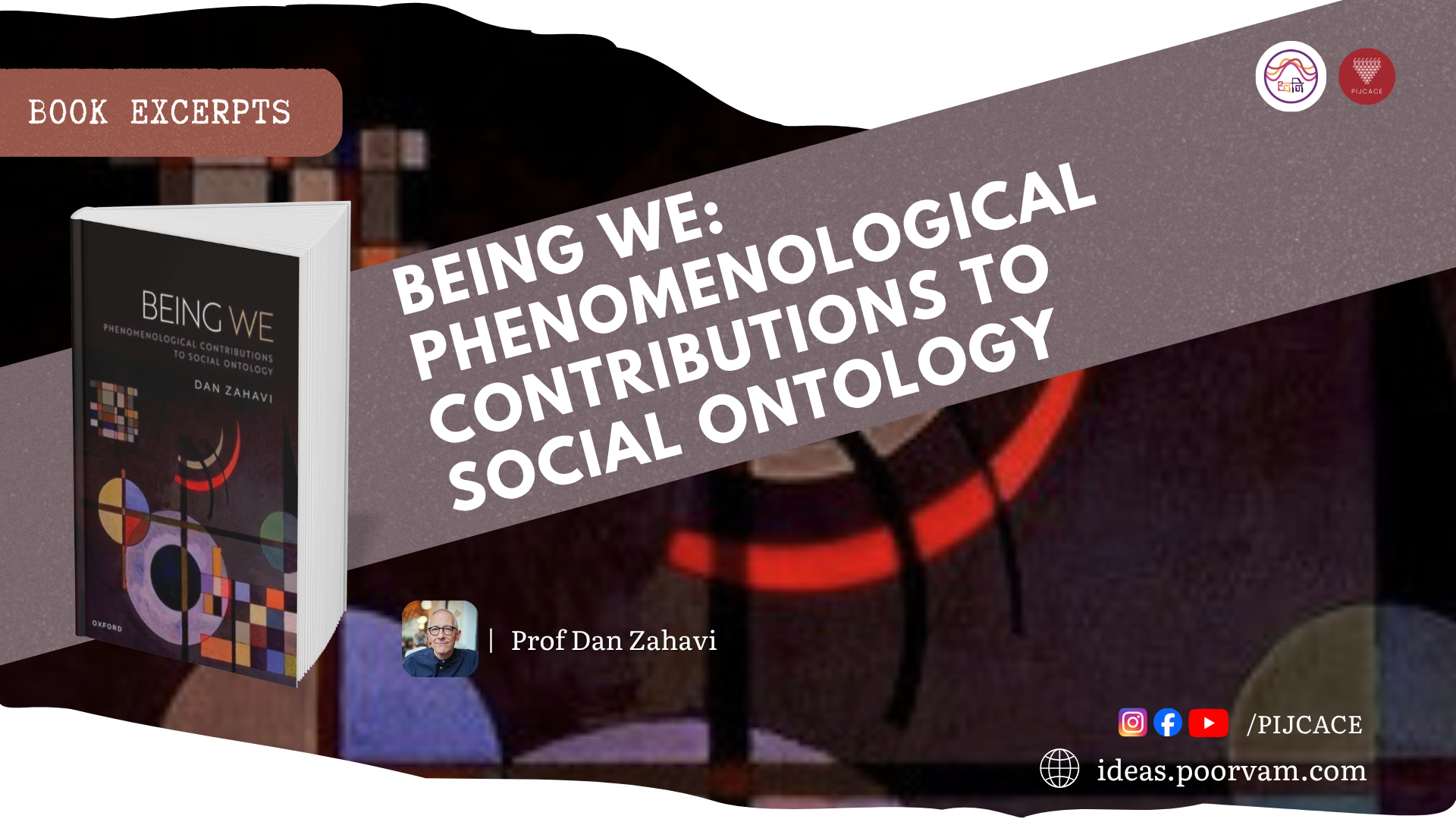
This is the puzzle at the heart of Dan Zahavi's Being We. When we say "we" — as in, "we won" — what exactly is happening? Is it just a shorthand for "you and I each won separately"? Or is something deeper going on, something that cannot be broken into parts?
Zahavi is a Danish philosopher who has spent decades studying consciousness. His answer, built carefully over 200 pages, is that the "we" is not just a grammatical convenience. It is a real and important part of human experience. And understanding it, he argues, requires us to also rethink the "I."
The book opens with a striking quote from a 19th-century Hasidic rabbi: "If I am I because you are you, and you are you because I am I, then I am not I and you are not you. But if I am I because I am I, and you are you because you are you, then I am I and you are you, and we can talk."
Any reader familiar with the Upanishads will feel an echo here. The idea that the self (atman) is not a sealed, independent container but is intertwined with a larger whole (Brahman) has been central to Indian thought for thousands of years. The Advaita Vedanta tradition goes even further: the separateness of the individual self is itself a kind of illusion, a veil (maya) over a deeper unity.
Zahavi does not cite these traditions directly, but the questions he is asking are old friends to Indian philosophy. Can there be an "I" without a "we"? Is individual selfhood something we begin with, or something we arrive at only through others?
Modern Western thought has largely assumed that the individual comes first. You are born as a separate person. Then you learn to cooperate, communicate, and form groups. The "I" is the original unit; the "we" is assembled later.
Zahavi calls this an "individualist bias." He points out, with some amusement, that many basic human actions simply cannot exist alone. You cannot argue by yourself. You cannot negotiate with yourself. You cannot confess or console in isolation. These are not things that start inside a person and then move outward. They are the interaction.
The philosopher Annette Baier put it boldly: perhaps separateness, not togetherness, is the thing that needs explaining.
This feels natural to anyone raised in India, where a person's identity is routinely understood through their relationships. You are someone's daughter, someone's eldest son, a member of a particular community or caste or region. Your name often announces these bonds before it announces you. The very idea of a standalone individual, with no social weight attached, is a relatively recent and somewhat foreign import.
Zahavi wants to understand the moments when being part of a "we" is not just a social fact but a felt experience. He gives a beautiful example from an early 20th-century phenomenologist, Gerda Walther.
Imagine a group of construction workers. They are from different countries. They do not speak the same language. They are doing the same job on the same site, cooperating smoothly, aware of each other. But according to Walther, they are not yet a "we." What is missing is something she calls the "inner bond" — a feeling of belonging together, of being unified, not just coordinated.
Now imagine a group of friends who meet every Sunday at the same chai stall. They argue, fall silent, crack jokes. Over months and years, something forms between them that is not owned by any one person. Something that would be lost if any one of them disappeared. That is closer to what Walther means.
Indians recognise this structure everywhere. In the sangha of Buddhist community. In the jati of caste. In a joint family household where "we" is not a pronoun but a way of life. In the way a mohalla (neighbourhood) grieves together when someone dies. These are not just collections of people. They are shared ways of feeling and being.
Here is where Zahavi's argument becomes most interesting. He does not just say that we form groups. He says that being part of a "we" actually changes what the "I" is.
When you genuinely identify with a group, something shifts in how you experience things. A victory is no longer yours alone. An insult to your community lands as an insult to you. You carry customs and values that are not really "yours" in the private sense, but that feel more central to your identity than your own preferences.
This has a parallel in how Indian sages described the gradual dissolution of the ahamkara, the ego, not through isolation but through deeper participation — in devotion, in service, in collective ritual. The "I" does not vanish; it expands.
Zahavi, ever careful, does not want to go so far as to say the individual self disappears. He keeps both truths in tension: you are genuinely you, and that "you" is shaped, enabled, and sustained by your "we."
At a time when the world often asks us to see ourselves as individual units — as consumers, as voters, as users of apps — this book is a quiet but firm pushback. The loneliness epidemic in urban India, the anxiety of the migrant who has lost their community of origin, the alienation of young people who are connected to hundreds online but close to very few in person: all of these speak to what happens when the "we" breaks down.
Zahavi's philosophy does not offer a fix. But it offers something better: a language for understanding what we lose when we lose each other.
Being We: Phenomenological Contributions to Social Ontology by Dan Zahavi was published by Oxford University Press in January 2025. Zahavi is a professor at the University of Copenhagen and one of the world's leading philosophers of consciousness and social experience.